
The Supreme Court has sought responses from the Centre, the CBI and others on a plea filed by a 78-year-old retired banker who was duped of Rs 23 crore after allegedly being put under "digital arrest" for nearly a month.
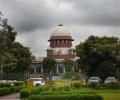
The Supreme Court has suggested that judges of the Jharkhand High Court take leave to write pending judgments, noting a significant backlog of cases where verdicts have not been pronounced.

The Supreme Court has framed key legal questions regarding the University Grants Commission's equity regulations and stayed the implementation of the framework on caste-based discrimination in higher education institutions.
The Supreme Court has expressed serious concern over the rising cases of digital arrest cybercrime in India, where fraudsters extort money from victims by posing as law enforcement officials. The court has vowed to deal with such cases with an iron hand and has sought reports from the Ministry of Home Affairs and the CBI.

It said that when a retiree, who withdraws amounts in the range of Rs 10,000 or Rs 20,000, suddenly withdraws huge amounts, then the bank should issue an alert.
The Supreme Court has expressed serious concerns about the rise in digital fraud, particularly digital arrest scams, and has directed the central government to develop a standard operating procedure to combat these crimes.

Supreme Court Justice B V Nagarathna dissented against the collegium's recommendation to elevate Patna High Court Chief Justice Vipul Manubhai Pancholi to the Supreme Court, citing concerns about seniority, regional representation, and the circumstances of his earlier transfer.

The court is hearing appeals against a CCI order imposing a penalty on Meta and WhatsApp.

The Supreme Court will hear on Wednesday a plea filed by West Bengal Chief Minister Mamata Banerjee challenging the ongoing Special Intensive Revision (SIR) of electoral rolls in the state.

The Supreme Court has directed the Election Commission to display the names of those on the 'logical discrepancies' list at various public offices in West Bengal, addressing concerns about irregularities in the voter rolls.
The bench, which asked Jain to withdraw the plea filed against a Delhi high court order that dismissed a writ petition challenging the registration and recognition of the AIMIM by the Election Commission (EC), granted liberty to the petitioner to file a writ petition, wherein he may make a wider prayer for reforms in respect of political parties on different counts.

The Supreme Court intervened to protect the Punjab Kesari newspaper from coercive actions by the Punjab government and its pollution control board, ensuring its continued publication.
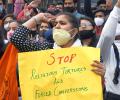
The Supreme Court has sought responses from the Centre and 12 states on a PIL challenging the validity of their anti-conversion laws. The National Council of Churches in India (NCCI) filed the PIL, seeking a stay on the operation of these laws.
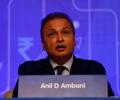
The Supreme Court on Friday issued fresh notices to Anil Ambani and the Anil Dhirubhai Ambani Group (ADAG) on a PIL seeking a court-monitored probe into alleged massive banking and corporate fraud involving the firm and its group companies.

A 36-year-old businessman in Delhi died after being allegedly assaulted by food delivery agents following a verbal argument. The incident occurred in Connaught Place, and the victim succumbed to his injuries after being hospitalized.

Hindus will offer prayers from sunrise to sunset on Basant Panchami while Muslims to offer namaz from 1 pm to 3 pm on Friday.

'My argument was straightforward: If the Constitution allows this reservation and SC/ST and OBC candidates are already getting reservation in private institutions -- backed by Constitution Bench orders -- then not extending the same to EWS candidates directly violates the 103rd Amendment and Article 14, which guarantees the right to equality.'
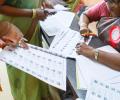
The Supreme Court of India resumed hearing petitions challenging the Special Intensive Revision of electoral rolls in Bihar, addressing the use of Aadhaar and concerns about voter deletions.
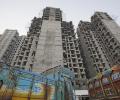
The Supreme Court of India has upheld an order directing NBCC to complete 16 delayed housing projects of Supertech Limited, providing relief to thousands of homebuyers who have been waiting for nearly two decades.
The Supreme Court of India has upheld an order directing NBCC to complete 16 delayed housing projects of Supertech Limited, providing relief to thousands of homebuyers who have been waiting for nearly two decades.
The Supreme Court expressed concern over threats to election officials in West Bengal and other states, urging the Election Commission to take action. The court also addressed the lack of cooperation from state governments in electoral roll revisions.
The Supreme Court dismissed a plea from a lawyer facing money laundering charges in the AgustaWestland VVIP helicopter deal, challenging a PMLA provision. The court stated that the lawyer should face trial like any other citizen.

"How can an officer be suspended for judicial orders which can be appealed against and rectified by the higher judiciary?" he asked.

The Supreme Court has questioned the 'arbitrariness' in the consideration of 'criteria appointment' for Short Service Commission (SSC) women Army officers seeking permanent commission, compared to their male counterparts. The court is hearing a plea from women officers challenging the denial of permanent commission.

The Supreme Court has stayed a recent University Grants Commission (UGC) regulation following petitions arguing that the Commission's definition of caste-based discrimination was too narrow, excluding certain categories from institutional protection.
The Supreme Court has directed the Election Commission of India (ECI) to publish details of deleted names from the voters list in Bihar, along with reasons for non-inclusion, to enhance transparency in the special intensive revision (SIR) of the electoral roll.

The Supreme Court has stated it will intervene if there is mass exclusion in the special intensive revision of electoral rolls in Bihar, emphasizing the Election Commission's role as a constitutional authority.

The Supreme Court expressed displeasure over the Allahabad High Court's orders regarding the Banke Bihari Temple in Vrindavan, questioning the use of intemperate language against the Uttar Pradesh government and staying further proceedings.

Chief Justice of India Bhushan Ramkrishna Gavai retired, reflecting on his career, commitment to the Constitution, and social justice.
A two-judge bench of the top court in 1981 questioned the correctness of the 1967 verdict holding Aligarh Muslim University not to be a minority institution since it was created by a central law and referred the issue to a larger bench for decision.

The Supreme Court has directed the Indian Air Force not to release Wing Commander Nikita Pandey from service. Pandey, who participated in Operation Balakot and Operation Sindoor, was denied a permanent commission despite being an expert fighter controller. The court raised concerns about the uncertainty faced by Short Service Commission (SSC) officers who are denied permanent commissions after years of service. The court emphasized the need for a system to accommodate all suitable SSC officers in permanent commissions, highlighting the excellent performance of women officers. The court has ordered the IAF to consider Pandey's case in a second selection board and has postponed the hearing to August 6.

The Supreme Court on Tuesday stayed trial proceedings against former Karnataka chief minister BS Yediyurappa in a sexual harassment case filed under the Protection of Children from Sexual Offences Act.
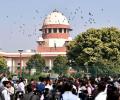
A woman lawyer was escorted out of the Chief Justice of India's courtroom after disrupting proceedings by persistently raising an unlisted case despite directions to stop by the bench.
The Supreme Court is examining the extent to which courts can intervene when governors delay or refuse to act on bills passed by state assemblies. The court questioned the Centre on whether judicial review is barred in cases of gubernatorial inaction, sparking debate on the balance of power between states and the central government.

The Supreme Court is considering entrusting the CBI with the investigation into digital arrest cases, citing the magnitude and pan-India spread of such crimes. The court has sought details of FIRs registered in different states and union territories and is monitoring the progress of the investigation.
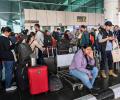
The Supreme Court declined to expedite a hearing regarding the widespread IndiGo flight cancellations, acknowledging the government's intervention in the matter.

The final day of the GOAT India Tour will also see Messi exchanging greetings with two members of the Indian cricket team at the Ferozshah Kotla Stadium.

The Supreme Court allowed a pregnant woman and her child into India on humanitarian grounds after they were pushed into Bangladesh.

The Supreme Court has directed the Maharashtra State Election Commission to complete the stalled local body polls by January 31, 2026, criticizing the commission for non-compliance with previous orders.
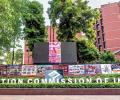
The Election Commission (EC) defended its power to revise electoral rolls and ensure no foreigners are registered as voters before the Supreme Court. The EC argued it has a constitutional duty to maintain the purity of electoral rolls and exclude those not eligible to vote.
 © 2026 Rediff.com - Advertise with us - Disclaimer - Privacy Policy - Sitemap - Feedback - About us - Terms of use - Grievances